
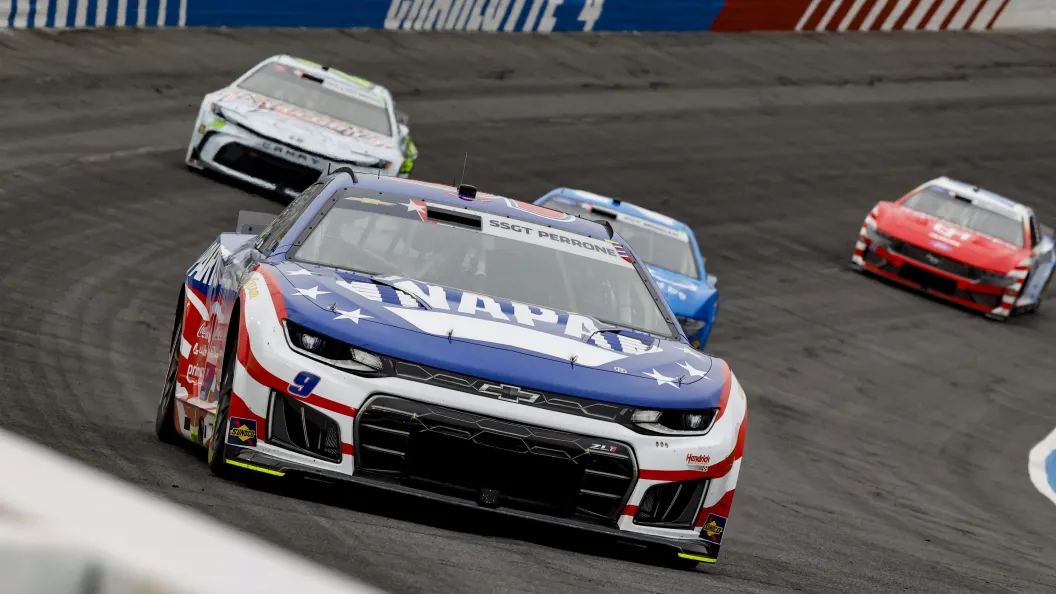
NASCAR has made major changes to the Rule Book ahead of the 2027 season. Chief among these changes is increasing horsepower at intermediate tracks on the schedule.
Videos by FanBuzz
According to the Friday update, the intermediate engine package will go from 670 horsepower to 750 horsepower. This goes into effect with the Coca-Cola 600 at Charlotte Motor Speedway, so the spring races at Las Vegas Motor Speedway, Texas Motor Speedway, and Kansas Speedway will still have the 670-horsepower package.
This is not the only horsepower change that will happen in 2027. The May 23 All-Star Race at North Wilkesboro Speedway will feature an 800-horsepower package, marking an increase from the 750 used at short tracks and road courses.
Once the All-Star Race is complete, NASCAR and the engine builders will have a debrief to examine the quality of the race and the engine performance. If the All-Star Race delivers, NASCAR will move to an 800-horsepower package at all short tracks and road courses, starting with the Bristol summer race on Aug. 14.
This increased horsepower is something that drivers and fans have requested for a considerable amount of time. Christopher Bell and Denny Hamlin, in particular, have called for more horsepower at intermediate tracks multiple times.
Increasing the horsepower at intermediate tracks is something that NASCAR acknowledged as a possibility back in March with an episode of the Hauler Talk podcast. NASCAR CEO Steve O'Donnell then said at Homestead-Miami Speedway in early November that the series would continue tweaking the Gen 7 car instead of moving into the Gen 8 era.
"You have pretty good racing," O'Donnell said. "The facts when you look at those compared to other sports are pretty strong. So I think it's important to look at what changes can you tweak along the way. But for us, we want a sustainable model for the industry.
"A Gen 8 or a Next-Gen car comes with all kinds of costs and all kinds of different things, so I'm confident in our guys and the industry and the OEMs to tweak what we have where necessary, but also be pretty confident in our drivers going out there and having the ability to go win races and put on some pretty darned good competition."
Other Big Changes to the 2027 Rule Book
The horsepower changes are the headline for the 2027 Rule Book, but they are far from the only notable takeaways. NASCAR updated several other areas while addressing some industry concerns.
Qualifying: NASCAR has made multiple changes to the qualifying format for 2027. One of the biggest is removing the second round from superspeedway qualifying. Drivers will just go out and complete one lap at the drafting tracks while setting the starting lineup. These drafting tracks will also have a qualifying-specific setup that furthers the goal of reaching 200 mph.
Additionally, NASCAR will no longer use the starting lineup metric to set the order if weather disrupts the session. The Team Owner Points standings will determine the lineup.
Wet weather tires: A complaint among crew chiefs and teams in recent seasons has been that they don't have freedom while racing in wet weather conditions. They haven't been able to decide when to pit and put slicks on the cars.
That changes with the 2027 season. Once the race has started and NASCAR has declared wet weather conditions, the crew chiefs can make decisions about the tire changes.
The double yellow line rule: The race at Talladega Superspeedway featured Kyle Larson making a stunning comeback and winning for the first time on the superspeedway. It also featured countless conversations about the double yellow line and whether Larson should have been penalized for going beneath.
NASCAR has now updated the language in the Rule Book in an effort to provide further clarification. The additional text states: "NASCAR defines beneath the double painted lines as follows: When the vehicle's left side tires are beneath the left line of the inside double painted lines that separate the apron from the racing surface."
Increased penalties for other series: The NASCAR Cup Series introduced a new penalty system when the Gen 7 car debuted in 2022. Teams could receive an L1, L2, or L3 penalty based on the nature of the violation. The L3 brought the stiffest penalties, such as potential team suspensions, the loss of 120-180 points, nullifying playoff eligibility, and fines up to $500,000.
The FedEx Freight Truck Series and NASCAR O'Reilly Auto Parts Series now have the L3 penalty as an option in 2027 and beyond.
Missing a race: NASCAR has updated the language in the Rule Book surrounding a driver missing a race without approval. The new language is as follows: "Before The Chase, the affected driver and/or Team owner will begin The Chase with 2,000 Points. All other qualified drivers and/or Team owners will retain the reset Points totals corresponding to their respective standing position as outlined in Table 12.4.2 Driver and Team Owner Points Adjustment.
"During The Chase, the affected driver and/or Team owner will have their respective Points totals reset to 2,000 Points. For the NASCAR O'Reilly Auto Parts Series, the driver/owner would reset to 2,020; in the NASCAR FedEx Freight Truck Series, the reset would be 2,030."
Splitter stuffers: The aero package for the short tracks and road courses will change with NASCAR removing the splitter stuffers at these specific tracks. These splitter stuffers go on the car's underwing next to the splitter wear blocks. They determine how air enters the underwing, and they help direct air along the outside of the car's underbody. The superspeedway package has smaller splitter stuffers than intermediate tracks.
Damper rules: NASCAR has taken another step to give teams more freedom in 2027 by removing the minimum damper length. This makes it possible to have more setup options at the various tracks on the schedule.
The current Rule Book has minimum extended damper lengths for different tracks on the schedule and for each side of the car. For example, the left front needed to be at a minimum 22.55 inches on the standard oval while the right front needed to be at 23.85 inches. The left and right rear dampers needed to be at a minimum of 21.65 inches and 22.65 inches, respectively.
Sealed engines: NASCAR has also updated the minimum number of sealed engines used during the 2027 season. The new language is as follows: "Teams considered to be full-time (i.e. entered in all Events for the current Race season) must compete in a minimum of 20 Points Events with a sealed engine during the Race season."
The 2026 Rule Book had the minimum number set at 17 points events. The schedule had to be submitted to NASCAR by Feb. 1, 2026.
