
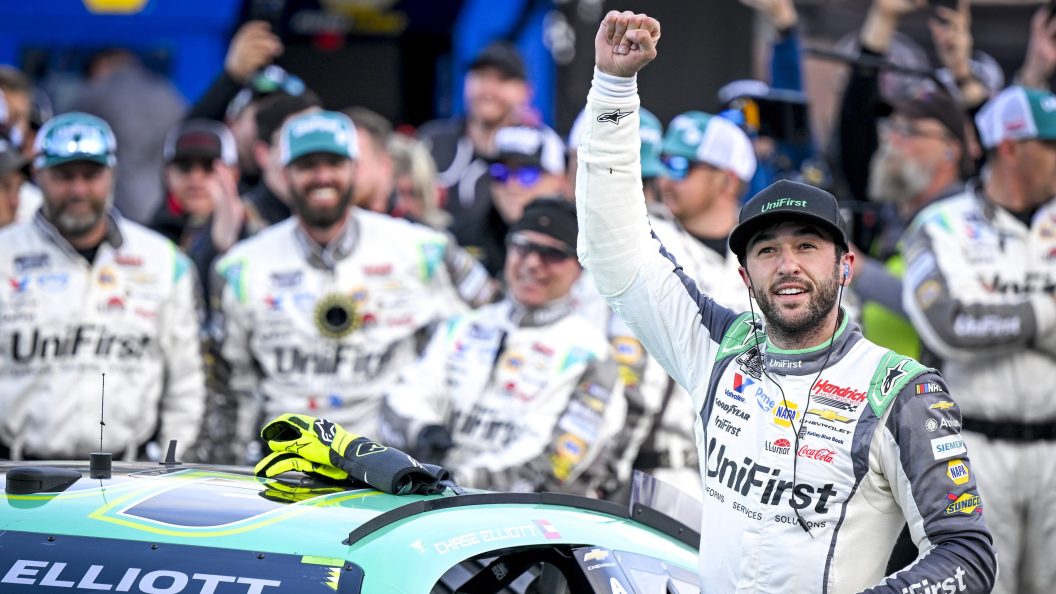
MARTINSVILLE, Va. — Winning a race often comes down which driver has the best car and the ability to keep it clean. Chase Elliott didn't have the fastest car Sunday evening at Martinsville Speedway, but he had three other factors heavily weighing in his favor.
Videos by FanBuzz
The No. 9 Hendrick Motorsports team had a solid strategy in place, faith in each other to execute it, and just a dash of intuition. These all played a big role in Elliott winning much earlier in the season than he ever had before at NASCAR's top level.
The Strategy
The strategy unfolded during the final stage of the race. Denny Hamlin had the dominant car, which he used to lead 292 laps and sweep the stage wins. But Elliott had crew chief Alan Gustafson, who went with a two-stop strategy at the Virginia track.
A stop with 138 laps to go took the 2020 Cup Series champion from the back edge of the top 10 to the lead. He didn't maintain this advantage, but he gained crucial track position. He only fell to second place before a late caution sent the entire field back down pit road.
At that point, the team could maintain its track position while stopping with the rest of the lead lap cars.
"I think probably where it turned a little different is when we pit, everybody basically at that time then has the same track position relatively, right," Gustafson said after the race.
"You're all spread around the track. So that advantage that the leaders had, it was diminished. When we pit, our lap times I think were pretty good and our falloff was less than expected, or less than the guys had run that run before.
"As soon as those guys who are going to one-stop then start shorting that by significant amounts of laps, that's playing into our hands, right? They've got to run a lot longer. Mathematically they're going to be worse."
The No. 9 team took a gamble, and it paid off in a big way for @chaseelliott. pic.twitter.com/FA4EJeg8Z1
— NASCAR (@NASCAR) March 29, 2026
The Team Faith
Gustafson did not solely decide to have Elliott do a two-stop strategy during the final stage at Martinsville. He had to consider all options while talking to his engineers. Opting for a two-stop strategy could help the team gain track position. It could also put them at considerable risk.
If a caution flew shortly after they made this pit stop under green flag conditions, they could remain trapped laps down. Instead of scoring a top-10 finish or better, they could have a poor finish after missing out on stage points earlier in the race.
For Gustafson, this was worth the risk considering that he didn't want to just run 10th all day.
"In this situation, Luke Mitchell, who is my race engineer at home, does a great job with strategy, we just continued to communicate about it," he said. "He told me that it was close, ultimately felt like it was a safer play to one-stop it.
"I asked him to go do some other calculations based on some different scenarios. He said it's probably a couple seconds faster. That was just enough for me then to say, yeah, it's worth it. We have to give ourself as shot."
Elliott also displayed some faith in his team. He could have questioned Gustafson in the heat of the moment. They've been together long enough that they can challenge each other on ideas.
This thought never crossed Elliott's mind. He's won enough races with Gustafson (21) atop the pit box that he's willing to ride with his longtime crew chief.
"I mean, I didn't think anything of it when he called me down pit road," Elliott said. "I tell Alan this, I've told him this throughout the course of the season, 'Hey, look, whatever you want to do, rip it. I'll support you whether it goes good or doesn't go good.'
"I think that is important for him to have that confidence. When he has confidence in a call, I'm going to have confidence in trying to make it work, because I want it to work, too. I want it to work out."
A strategy call that paid off.
A dominant car that fell just short. pic.twitter.com/7RfL7474V0
— NASCAR (@NASCAR) March 29, 2026
The Intuition
Call it a gut feeling, call it intuition — regardless of the term, this played a key role in the final stage of the race. Elliott used this to take control of the race, which put him in the lead for the final 69 laps.
The caution flew for debris with just under 90 laps remaining in the short track race. Hamlin had the lead with Elliott in second. They both headed down pit road with the rest of the leaders while Ross Chastain gambled and stayed out on old tires. This put him in control of the restart.
Chastain took the bottom for the restart while Hamlin took the outside. Elliott lined up on the bottom in the second row. Once the field took the green flag Chastain cleared for the lead while Hamlin struggled on the restart.
The caution then quickly flew for a multi-car pileup that set up another restart. Though it occurred after Elliott nosed ahead of Hamlin. This put him as the second car in the choose for a pivotal restart, and it set up a decision.
BIG TROUBLE! 👀 pic.twitter.com/M9tS3025ny
— FOX: NASCAR (@NASCARONFOX) March 29, 2026
Would he go on the bottom and line up behind Chastain again, or would he take the top as Hamlin did before him and hope for a better result?
"Honestly, for as bad as (Hamlin) struggled on the restart before, as good of a launch as Ross got, I debated on taking the bottom just to not have the same thing happen and get stuck on the outside," Elliott said.
"Man, I just did not want to look back and be like I gave up an opportunity of the front row. Feel like I had to take that chance."
As Elliott said, the move worked out. He took control of the race and managed the pace for the final 69 laps. He scored his first win of the season, and he scored 55 crucial points. He also set up an opportunity to head into the bye week riding a good feeling.
