
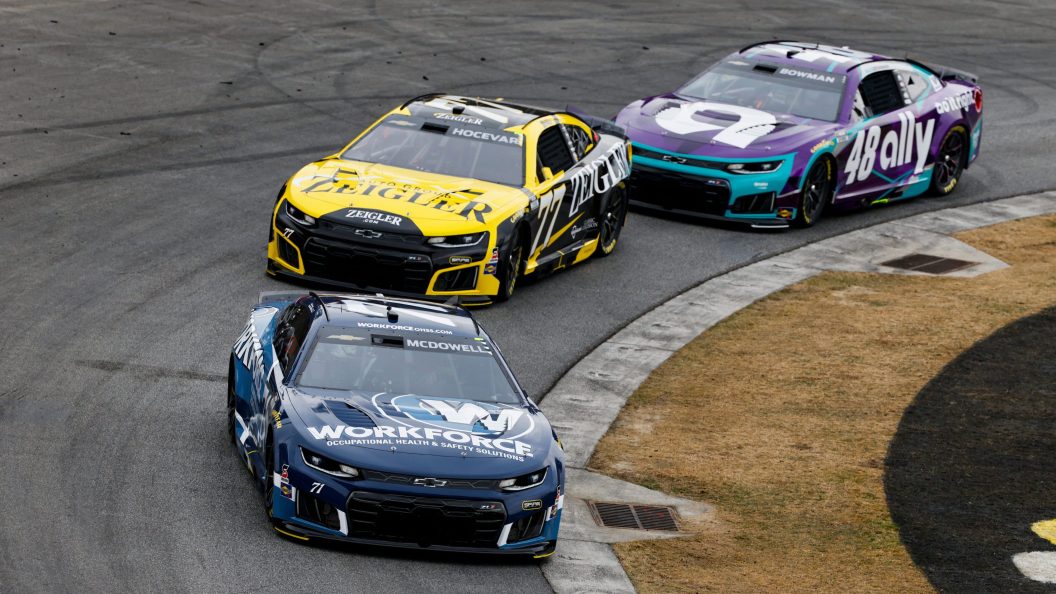
Chevrolet has won the manufacturers' championship every season of the Gen 7 era, but the OEM partner will face some questions entering 2026 after updating the body of the Cup Series car.
Videos by FanBuzz
The Camaro hasn't drastically changed for the 2026 season. However, the updated body features a larger hood power dome, a revised front grille, and more pronounced rocker panels along the sides of the car.
The drivers don't yet know how this version of the Camaro will perform while racing in a pack, and they certainly won't have a full idea until March.
"I mean, I'd be lying to you if I told you I know what it's going to do and not do," Michael McDowell said in response to a question from FanBuzz.
"I've been through this before, like you've talked about, where there's a lot of hope and there's excitement, and then you get there, you go, 'Oh, that's not much different.' So I'm not sure what to expect."
On paper, the updated body should not present much of a change as Chevrolet teams try to maintain an advantage over those representing Ford and Toyota.
But even minor changes can affect how the cars handle in the draft at Daytona or how they can deliver bumps in traffic. This is something that Toyota and Ford teams learned in recent seasons after moving to updated bodies.
Prior to the 2024 season, Toyota revealed the Camry XSE while Ford revealed the Mustang Dark Horse. Neither body presented a drastic change from the early Gen 7 cars, but the updates still created a learning curve for the respective teams.
Ford teams, in particular, went winless the first 12 weeks of the 2024 season. Brad Keselowski snapped the streak by winning at Darlington, five races after he told media members that they had discovered some things they needed to change while adapting to the Dark Horse.
"There were some things that we found that we don't think are realistic, for good and bad," Brad Keselowski said at Martinsville Speedway in 2024.
"And I think we've got a mitigation plan around them that will come into effect in the next few weeks, and hopefully show improvement for us."
The Chevrolet teams hope to avoid a similar learning curve while adapting to the updated Camaro body. They just won't know if it is truly possible until they actually hit the track in consecutive weeks.
"Going to Daytona, we will have a good idea of if this was a help for the superspeedways," McDowell added. "If it is draggier, if it's more downforce, all those things.
"But really, you don't see where you stack up with all that, I feel like, until you get to probably Vegas. A fast mile-and-a-half, and you really see how much the new body affects the aero balance."

Photo credit: Chevrolet
The first week of the season will provide some answers, but only to a point. The teams will have three practice sessions, one qualifying session, and two Duel races before they take on the Daytona 500.
This extended time on the track will help them build out the notebook, but it may not directly translate to the best setup at EchoPark Speedway (Atlanta) in Week 2. This 1.5-mile drafting track emphasizes handling far more than Daytona.
The schedule continues with a road course in Circuit of the Americas (March 1), a 1-mile oval in Phoenix Raceway (March 8), and then the first traditional 1.5-mile oval in Las Vegas Motor Speedway (March 15).
This Nevada track will serve as the true benchmark. It will show which teams will be contenders, as it has in prior seasons, and it will let Chevrolet teams know exactly what they have in this new body.
Not that McDowell or any other Chevrolet driver expects a major dip in performance. They may not win 15 races again as they did in 2024 and 2025, but they will still remain in contention for double-digit wins.
"Everybody's still working inside of that same bubble, in that same box, right. The golden standard," McDowell said. "So there's not huge gains to be made, but there are balance shifts. And so we'll see how that works out.
"But you just trust your partners. Like, everybody at Chevrolet worked really hard on this, and it's not something that they did thinking, 'Oh, hey, let's make this worse, right?' They obviously wanted to find gains and match their styling on the road. So hopefully it does all the things that we hope it to do, but you don't know until you hit the racetrack."
