
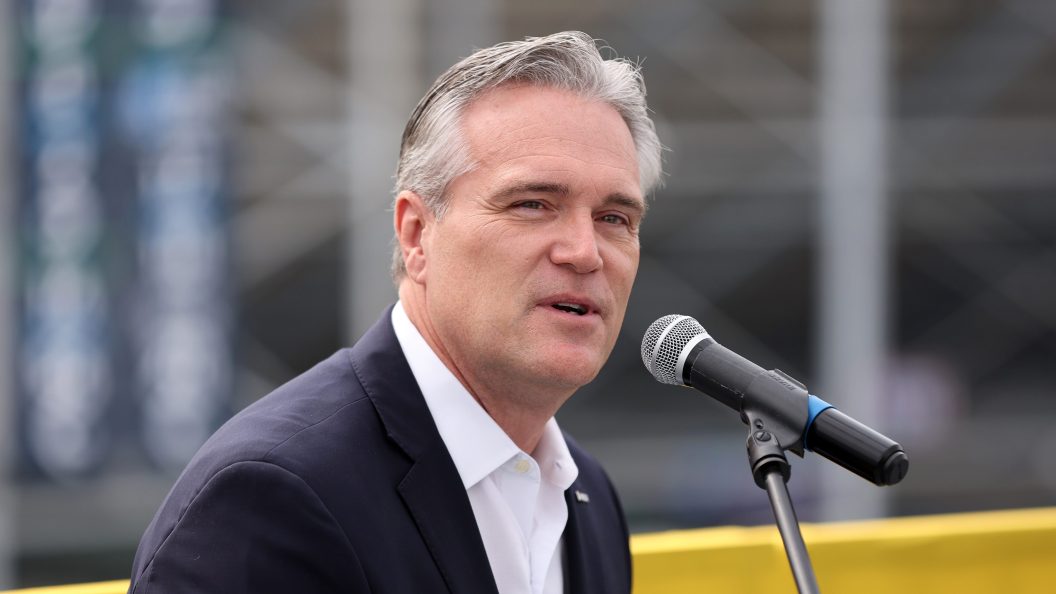
CHARLOTTE, N.C. — NASCAR's legal team began presenting its case on Wednesday as an antitrust trial unofficially moved into the second half.
Videos by FanBuzz
This antitrust trial stems from a lawsuit filed in October 2024 by 23XI Racing and Front Row Motorsports. The two teams alleged that NASCAR and CEO Jim France used anti-competitive acts to maintain an illegal monopoly and enriched themselves "at the expense of the premier stock car racing teams."
Plaintiffs in this case (23XI Racing and Front Row Motorsports) took just over seven days to present their side to the North Carolina jury. They rested their case at 9:45 a.m. on Wednesday after finishing examination of France. This then put Defendants (NASCAR and France) into the driver's seat.
NASCAR's legal team only called three witnesses to the stand on Wednesday. This included Chief Financial Officer Greg Motto, expert witness Professor Mark Zmijewski, and Executive Vice President & Chief Racing Development Officer John Probst.
Note: we will focus on Probst for this story. Professor Z will finish his testimony Thursday, which also ties into Motto's time on the witness stand.
Probst focused on numerous topics during his time on the witness stand, starting with his history at Red Bull Racing and Chip Ganassi Racing. He also spoke extensively about the CART and IRL split, which had lasting effects on the open wheel racing world. Probst worked at Ford as an engineer during this era and had an up-close look at the situation.
However, the Next Gen car and team budgets became the biggest focus of Probst's testimony. According to the executive, who joined NASCAR after the 2016 season, the sanctioning body has spent $14 million so far in developing the Next Gen car. This includes testing and safety concerns. He said that NASCAR continues to spend $2.5-3 million annually for testing purposes.
On lunch recess. Kessler just finished cross exam of John Probst. NASCAR redirect is next.
- before the break, Probst said that new OEMs entering the sport was good. Caused existing OEMs to renegotiate deals to pay teams more.
- Probst said that NASCAR has spent $14 million so…— John Newby (@JohnNewby_) December 10, 2025
"Did the teams help pay for the development costs?" NASCAR's attorney asked Probst multiple times during direct examination. He responded by saying, "no." Defense then showed an email to the teams saying that NASCAR would "bear the brunt" of the development costs, which they estimated to be $10-12 million.
In terms of the actual car costs, Probst faced numerous questions. He discussed the Next Gen parts and pieces, as well as whether it costs $20 million to field a car in the Cup Series.
This latter question is actually something Probst and NASCAR examined through an exercise. They estimated that it would cost $19.9 million to field one car. Probst clarified that this included startup costs and an estimated driver salary of $2.5 million. He did not factor in the price of a charter.
The executive said that the price would drop to $15.8 million for the first car if they removed the driver salary and startup costs from the equation. Probst said that a second car without these factors would cost $12.3 million. When faced with team comments about paying $20 million per car, Probst said that it seemed a little high.
The executive sought to further highlight his point about car costs. He faced a question about teams saying the Gen 7 car has increased costs and responded by saying that "competition drives costs."
Probst said that these increasing costs are on the teams who want "private planes," "fancy war rooms," and "nice buildings." He said that having these items was "their prerogative."
While NASCAR's side of the case highlighted the Gen 7 car, the costs, and the teams who spend the most on parts and pieces, Plaintiffs took a different approach. Lead attorney Jeffrey Kessler focused on other details, such as car restrictions.
Kessler asked if NASCAR was just focused on fan interest, cost savings, or more competitive racing, why did they have to restrict the cars? Why couldn't they license teams to use the Gen 7 car in other events or series while protecting the IP from the outside world?
"Coke won't create a new recipe and then give it to Pepsi," Probst responded. He said that he doesn't understand the emotion surrounding the IP restrictions. "No one ever asked!" he said repeatedly.
Probst also said multiple times that NASCAR has no problem with competition; they just don't want a "copy cat" series. He said this is why he used this particular phrase when discussing future car options, which included the Gen 7 car and the Gen 6*. The latter of these cars was a modified version of the Gen 6 car that NASCAR contemplated before ultimately changing paths.
"If NASCAR is fine with competition, why would Steve Phelps want to put a knife through SRX," Kessler asked. Probst said that the current NASCAR Commissioner would have to answer that particular question.
More notes from Probst's testimony
- Probst acknowledged on Wednesday that he "contributed heavily" to the Gold Codes document. He also used some data from the project estimating the cost of fielding a Next Gen car. This Gold Codes document was a contingency plan if teams chose to boycott races or leave the series entirely. In this document, NASCAR outlined a plan to field all of the cars itself, which would cost more than $600 million at first.
- Defendants' attorney asked Probst if NASCAR charged for WiFi at the race track, something that a previous witness alleged. "NASCAR offers WiFi at the track," Probst responded. "It's up to the teams to decide if they want to subscribe." The top tier of this internet is approximately $150,000 per year. The lower tier is about $1,000, per Probst.
- Probst testified that having a new OEM is good for the sport. He said that a new OEM would force the existing OEMs (Ford, Chevrolet, Toyota) to renegotiate with teams to get them more money.
- Probst said that NASCAR worked with a Canadian company to determine what was an entertaining race and what was a competitive race. He said that fans viewed a popular winner (Dale Earnhardt Jr.) as a factor in an entertaining race. He added that a race with an unpopular driver would rate lower even if it had 17 lead changes and 1,000 passes.
- The NASCAR executive said that Red Bull Racing didn't go out of business. He said that the team left the sport because it did not dominate as expected.
