
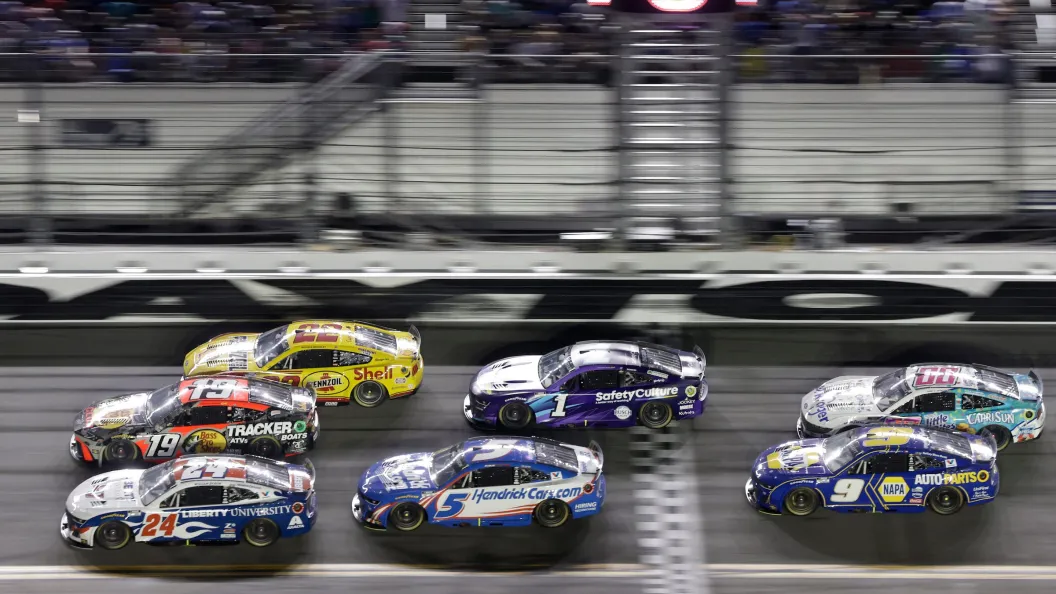
The regular-season finale at Daytona International Speedway will feature a major change. NASCAR will update the superspeedway package while trying to replicate the most exciting track on the schedule.
Videos by FanBuzz
According to a Wednesday press release, the superspeedway pacakge will have four main changes. The biggest of these is the move from a seven-inch spoiler to a four-inch spoiler. The size of the taper also changed to drop the horsepower down to 465.
Superspeedway Package Changes
- 4" spoiler and wide splitter stuffers (same as intermediate)
- Engine tapered spacer reduced to 27/32" ~ 465 HP
- New spoiler braces
- Spoiler deflection device redesigned to accommodate 4" spoiler
How will this affect the racing? According to NASCAR, the expectation is that single-car speeds will be 2-3 mph faster than they are in currently qualifying sessions. The expectation is that the maximum pack speeds remain in the same range even with the reduced horsepower numbers.
NASCAR's simulations also indicate that completion of a pass with a 5-mph run is more likely with this updated superspeedway package.
The safety equipment used at other superspeedway events will remain the same for Daytona International Speedway.
"What we're essentially trying to recreate is Atlanta at Daytona," Denny Hamlin said during an interview with analyst Steve Letarte and President of NASCAR Event Management John Probst. "It happens organically at Atlanta, the space between the cars, because the cars themselves are grip limited.
"And the fuel mileage really doesn't happen because you have to be on offense constantly. I can tell you from the driver's seat what happens for us is that we spend the entire race fuel mileage saving all for that last pit stop."
RULE CHANGE ALERT 🚨@dennyhamlin and NASCAR Event Management President John Probst join Inside the Race to break down the new spoiler package for Daytona and superspeedway racing.
What's changed and what it could mean when the green flag drops? pic.twitter.com/TlgKStojSh
— Steve Letarte (@SteveLetarte) July 15, 2026
To Hamlin's point, the superspeedway races at Daytona and Talladega have sparked criticism for how they have played out in the Gen 7 era. The drivers have focused more on fuel saving than on actually racing, so they spent the first two stages running two- and three-wide at partial throttle.
Only after the final pit stop did they actually begin racing for position. Of course, the change in aggressiveness led to wrecks in the final stage.
NASCAR updated the stage lengths for the spring race at Talladega in an effort to prevent the blatant fuel saving. The first stage became the longest as NASCAR effectively flipped the script.
Probst said at the time that altering the stage lengths served as one method for improving the superspeedway racing. He indicated that NASCAR would also change the package.
"There's certainly a lot of feedback from the fans that don't always like to see some of the three-wide fuel saving that happens mostly at Talladega and Daytona," Probst said in April.
"And I think that coming out of Daytona, we have been working hand-in-hand with a lot of our race teams, trying to largely break into two categories of things that we could do.
"One being the sporting-related things, like rules around pit stops or stage lengths or things of that nature. The other being in a technical bucket, which would mean car changes, spoiler, power levels, and things of that nature."
