
CHARLOTTE, N.C. — All 16 drivers locked into the Chase know that points and wins can propel them to a Cup Series championship.
Videos by FanBuzz
But with NASCAR ditching the elimination format and moving to 10 races, restraint is arguably equally as important.
"If we have a day that we can run eighth and that's it, then we're gonna figure out how to run sixth," Chris Buescher said to FanBuzz during Chase Media Day.
"That doesn't mean taking a wild shot from out of nowhere and crashing and finishing 35th. I think that's what has helped get us to this point."
For drivers who earn a living racing at nearly 200 mph, showing restraint is not something mentioned as frequently in conversations. Yet, it's an incredibly important part of the job.
These drivers must show restraint when saving tires at Darlington Raceway and Martinsville Speedway. They must avoid putting too much stress on their brakes at Gateway. They must choose when to accept that they have a sixth-place car instead of pushing hard and wrecking.
If a driver burns up his tires too quickly, they could fall off the pace or hit the wall. They could miss out on crucial stage points.
Even paying too much attention to the other Chase contenders could wreak havoc on perfectly laid plans.
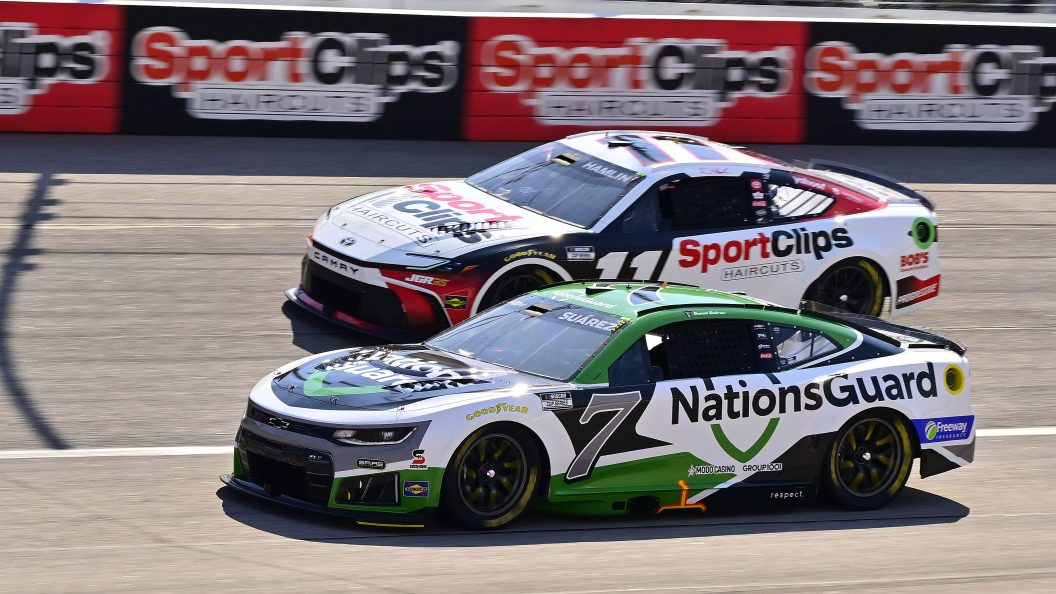
"Sometimes, as a driver, we want to do too much, and there's only so much that is under our control," Suarez told FanBuzz. "You know, the only car I can control out there is the No. 7 car and the No. 7 team.
"I don't care about what the other guys are doing or not doing. We have to just control what we can control, and if we can focus on that and maximize that, I feel that we're going to be in a pretty good spot."
This restraint is something that takes some drivers more time to learn. Bubba Wallace acknowledged as much while raising his hand and laughing after hearing the question.
But he feels that he's making progress as he prepares for his third appearance in NASCAR's postseason.
"I think you realize your potential, for me, early on in a race, but it doesn't mean you settle for sixth in stage 1," Wallace said in response to FanBuzz. "It's, like, OK; we are only good enough for sixth right now, let's see how stage 2 goes.
"If you are still sixth, maybe it is a sixth-place day, instead of trying to turn a sixth-place day into a first-place day and hitting the wall or running in the back of somebody and making it a 12th-place day. I think just understanding that and not being okay with being a winning car."
The postseason has always tested the mental strength of NASCAR drivers; it just did so in a different manner. The elimination format, for example, had opportunities to breathe.
Sure, a driver could crash in the first race of a three-race round and fall below the cutline. But if they won, they would automatically advance to the next round. Even if they just skirted through each round on points, they would get a chance to catch their breath when the points reset.
Now, the points never reset. The drivers just take the green flag at Darlington Raceway and then race for 10 weeks. They get no breaks, no chances to catch their breath, and no relief from the constant pressure.
Now, a lack of restraint means that they could quickly eliminate themselves from championship contention.
"The previous format and system, it was just three races at a time," Christopher Bell said. "And if you had a bad race, it's just like survive. Just gotta get above the cut line. Got to get above the cut line.
"Once you get above the cut line, 'Okay, we're in great shape now' if you have a lot of bonus points or whatever. Where now, there are no freebies. You can't have a bad race and get a reset in three weeks. So, you're going to have to perform every week."
