
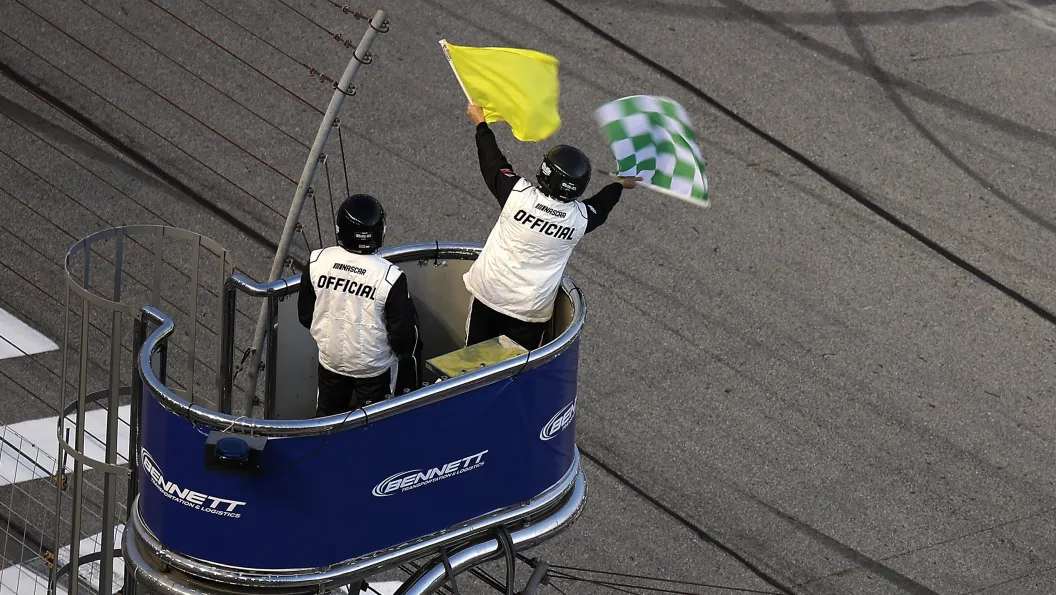
NASCAR is examining potential procedural changes following a race at Indianapolis Motor Speedway featuring lengthy caution periods.
Videos by FanBuzz
Speaking on the latest episode of Hauler Talk, vice president of racing communications Mike Forde said that NASCAR is aware of the fans' anger over caution lengths. He added that the sanctioning body "matches that displeasure."
Changes could happen as NASCAR seeks to go back to green flag racing faster. Although Forde shut down the notion of removing stage break cautions. These mandatory breaks in the race still remain after Indianapolis, and they will remain moving forward.
"It's important to us to get back green," Forde said. "We keep stats religiously on blocks of time between yellow and green flag racing. We want to have as much as possible, so we're always working to get that green (flag) number higher and higher.
"Obviously, stage breaks are a big topic of conversation. We hear it, we see it, and so I don't have any news there. And I'm afraid to even talk about it."
The caution periods at Indianapolis sparked criticism as drivers battled for the crown jewel win. Kyle Larson crashed late in stage 1 of the race. This set up a late dash to the stage end. The race then went under caution for the break.
The end result is that fans saw one green flag lap in approximately 25 minutes.
Kyle Larson blows a left rear tire and crashes hard in Turn 3 at the Brickyard 400 😬 pic.twitter.com/9Jtc4j1QDP
— TNT Sports U.S. (@TNTSportsUS) July 26, 2026
Daniel Dye, a part-time driver, then crashed late in stage 2. This caution actually ended the stage and extended the amount of time that the drivers spent slowly circling the track.
The cautions are not straightforward in terms of simply throwing the yellow and then lining up and going back green. The time cleaning up the wreck plays a major role in the time of the caution.
The field also has to wait for the pace car to pull back out front. The car receiving the free pass then has to circle the track and pass the field. After that, pit road opens for any drivers needing fresh tires and fuel.
Once the field has gone through all of these processes, they must then choose the inside or outside lane. This extends the caution period by one lap.
The amount of time spent under caution led to countless angry comments on social media, something of which NASCAR is well aware.
The @danieldye43 / Stage 2 conclusion caution was the longest caution, in terms of minutes & laps, of the race, 8 laps.
In total, today's @NASCAR Cup race had 27 laps run under caution, for a total of 1 hour, 14 minutes, and 31 seconds.#NASCAR | #Brickyard400 | @jeff_gluck https://t.co/qn03qP1rB2
— Seth Eggert (@SethEggert91) July 27, 2026
"If NASCAR fans are angry at the length of caution periods, I can promise you that NASCAR matches that displeasure," Forde said. "We want green flag racing, and we want to get it as fast as possible."
Debates about race lengths have raged since six-time IndyCar champion Scott Dixon made a comment about Cup races being "hard to watch" and that it's good for a nap.
Many people in the industry pushed back against Dixon's comments. Some agreed that races are too long, especially those that start late on Sunday nights.
Larson, a two-time Cup Series champion, also addressed this during his media availability at Indianapolis Motor Speedway.
"Well, I'll start off by saying yes, I agree that a lot of our Cup races are too long," Larson said." I just think the way that the world has kind of gone and how people consume sports, I definitely think our races are too long.
"I think three hours is too long. But as far as a nap, I don't know, it doesn't really bother me. But I agree with what he was saying."
